Guide II
Big Bad Wolves
No animal has played the villain longer than the wolf. It prowls through fables, fairy tales, music and film, and every century seems to tell its story a little differently.
The fable wolf
In the fables credited to Aesop, the wolf is greedy and cunning but often outwitted. It disguises itself in a sheep’s skin, argues with a lamb to justify eating it, and ignores the boy who cries wolf until it is too late for the sheep. The lesson is usually about people, not animals.
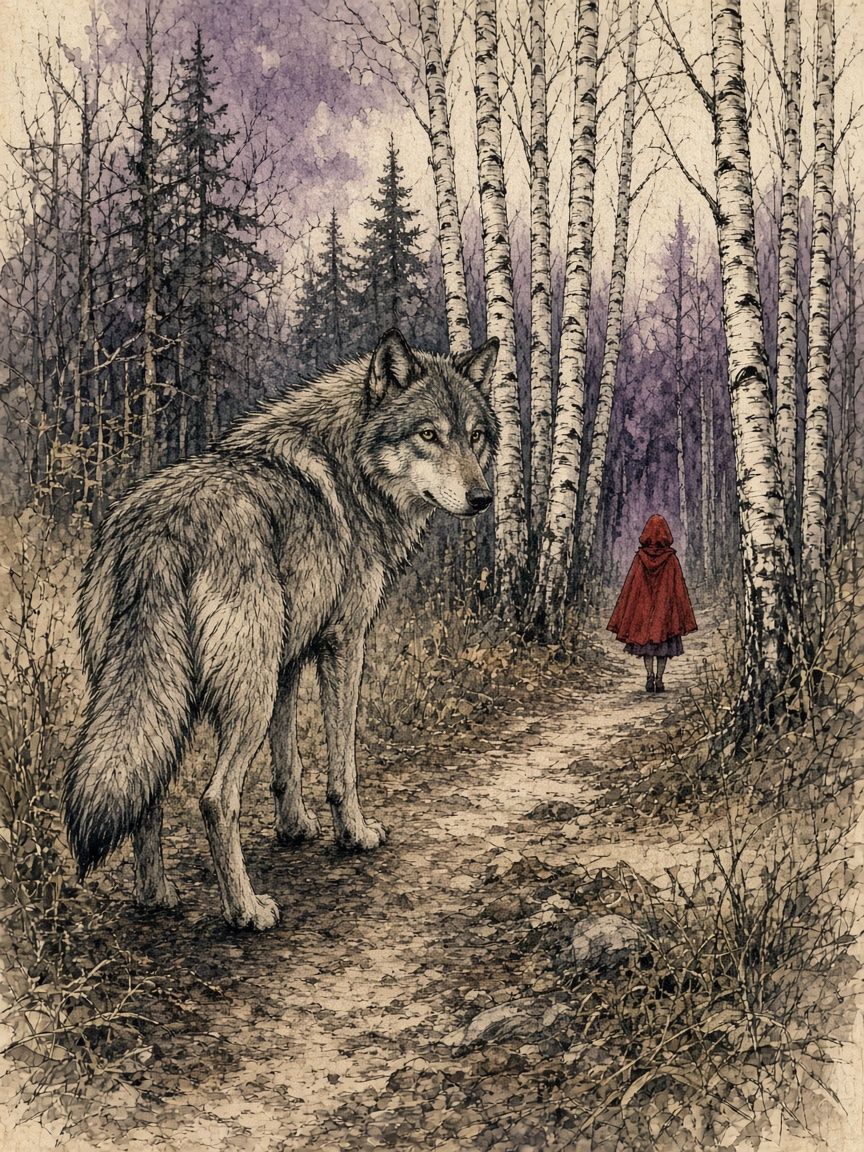
Little Red Riding Hood
- Perrault, 1697. Charles Perrault’s version ends with the wolf eating both grandmother and girl, followed by a short verse warning young readers about smooth-talking strangers.
- The Brothers Grimm, 1812. Their Little Red Cap adds the huntsman who cuts the wolf open and frees them both. The famous exchange about big eyes, big ears and big teeth becomes the heart of the tale.
- Older oral tellings. Folklorists have recorded earlier versions in which the girl escapes by her own wits.
Huff, puff and three little houses
The Three Little Pigs was printed in English collections of nursery tales in the nineteenth century. Straw, sticks and brick give children an easy pattern to remember, and the wolf’s repeated threat to huff and puff is one of the most quoted lines in children’s storytelling.
A wolf with an orchestra
Sergei Prokofiev’s Peter and the Wolf (1936) gives each character an instrument. The wolf is played by three horns, which is why so many people still hear French horns as quietly menacing.
Why the wolf, and not the bear?
| Trait | How stories use it |
|---|---|
| Hunts at dusk and night | Darkness, the forest edge and the walk home |
| Lives in packs | The danger of the group, the loner who has left it |
| Howls | A warning heard before anything is seen |
| Looks like a dog | The familiar turned dangerous; perfect for disguise |
The wolf retold
Modern retellings like to flip the script. Picture books let the wolf tell its side, novels make the wolf a lonely outsider, and films turn the forest into a place of choice rather than threat. Real wolves, now returning to parts of Europe and North America, have helped soften the image.
Real wolves are not storybook wolves. Wild wolves are shy and usually avoid people. The fairy-tale wolf is a character, not a field guide.